Zoome KYC Verification: Documents and Checks
 Available in AU
Zoome can ask account holders to complete identity verification, including before a withdrawal is processed. Its current Terms list a government-issued photo ID and proof of current address among the core documents, with additional identification or proof connected to a payment method possible when requested. The operator’s FAQ says account verification usually takes up to 24 hours after documents are submitted, although that is a typical timeframe rather than a guaranteed deadline.
For Australian users reading the Zoome review, the practical point is simple: accurate account details and clear documents reduce avoidable back-and-forth. KYC is not the same as registration, and an account that has already been used for deposits or games can still be asked to complete verification later. If a withdrawal is waiting on checks, the quickest route is usually to answer the specific document request rather than upload unrelated files.
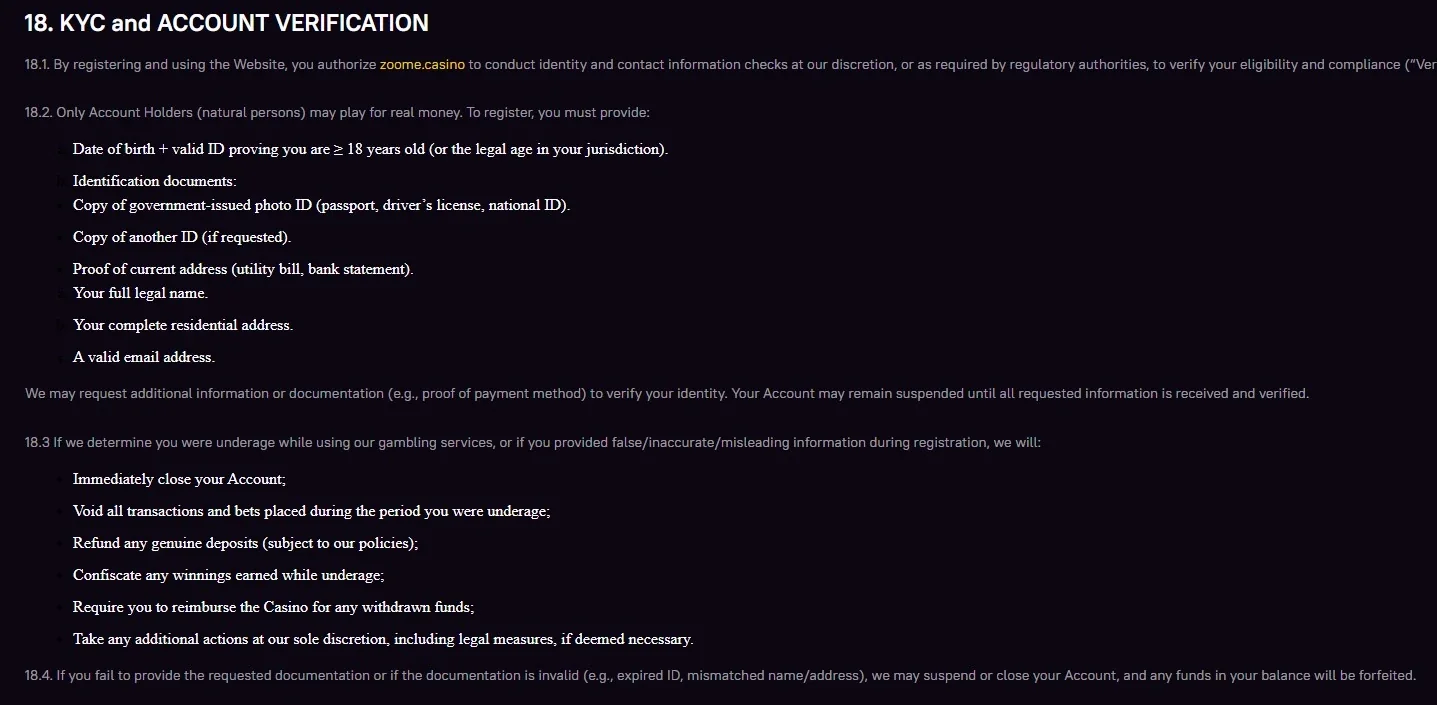
Table of Contents
- Which documents can Zoome request?
- What information should match your account?
- How long does Zoome verification take?
- Can KYC affect a withdrawal?
- Why might Zoome ask for more information?
- How to prepare documents that are easier to review
- What happens if a document is rejected?
- Privacy and document handling
- KYC checklist before a cashout
Which documents can Zoome request?
Zoome’s current Terms identify the main document categories directly. The first is a copy of a government-issued photo ID, with examples including a passport, driver’s licence or national identity card. The second is proof of current address, with a utility bill or bank statement given as examples. The Terms also allow the operator to ask for another form of identification and additional information or documentation when needed.
Payment-method evidence can form part of that additional request. That does not mean every user will be asked for the same payment document. It means the operator reserves the right to verify that the payment method and account activity belong to the registered account holder. This is especially relevant if the account has been funded by card, bank route or another named payment instrument.
Do not build your document pack around lists copied from unrelated casinos. Zoome’s published requirements are broad enough that the exact follow-up can depend on the account. If support requests one specific document, answer that request first instead of sending a large bundle of files that was never requested.
What information should match your account?
The Terms require personal details such as date of birth, full legal name, residential address and a valid email address. Verification is designed to connect those account details with real-world evidence. A name entered differently from the identification document, an old residential address, or an expired document can therefore create an obvious mismatch.
The safest preparation starts before KYC is requested. During account setup, enter your legal details accurately and avoid using another person’s payment account. If you later move home, change a legal name or replace an expired ID, be ready to explain the change and provide current evidence if Zoome asks for it.
Readable files matter as much as correct information. A valid document can still be difficult to review if important text is cropped, blurred or hidden by glare. Include the full document where practical, keep all corners visible, and make sure names, dates and addresses can be read without zooming into a heavily compressed image.
How long does Zoome verification take?
Zoome’s current FAQ says account verification usually takes up to 24 hours after documents are submitted and can be completed faster. Treat that as the operator’s usual timeframe, not as a guarantee that every case will finish within exactly one day. A request for more information, a rejected image or a mismatch can extend the process.
The timing also starts to make sense only once the requested material has actually been supplied. If an account is waiting for a proof-of-address document and only an ID has been uploaded, the review is not really complete from the operator’s point of view. The same applies if a file is unreadable or no longer current.
If the process runs longer than expected, Zoome directs users to support. The operator provides 24/7 live chat, which can be useful for confirming whether the review team is still waiting for something. Support can explain the account status, but it is better to avoid repeatedly submitting replacement files unless the operator asks for them.
Can KYC affect a withdrawal?
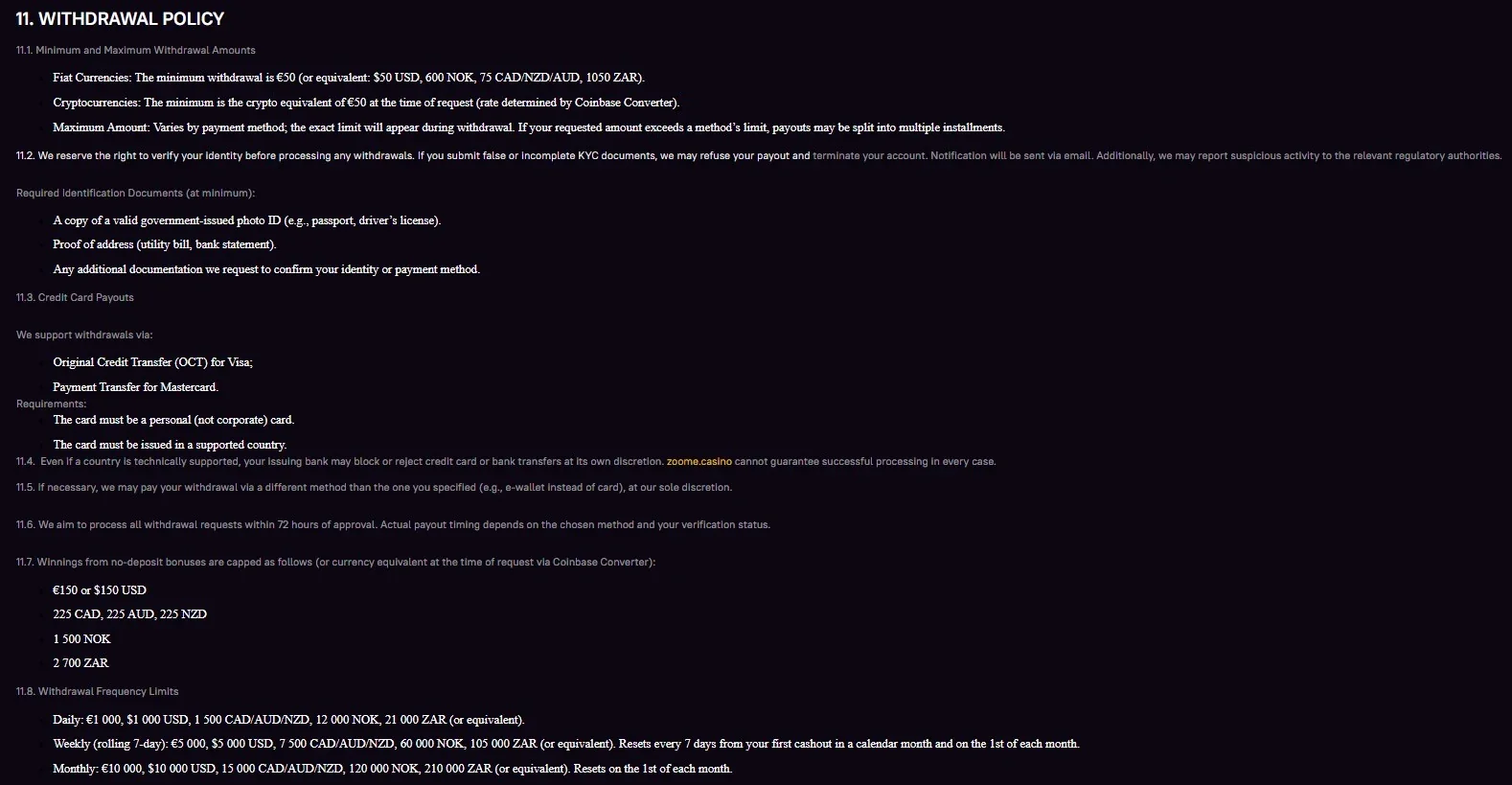
Yes. Zoome’s published rules allow verification to be requested before withdrawals are processed. That means a cashout request can pause while identity checks are completed even if deposits and gameplay were previously available. This is a common point of confusion because registration, depositing and withdrawal approval are separate account stages.
If your main concern is a pending cashout, use the dedicated withdrawal verification for the current AUD minimums, standard limits and processing conditions. The important connection here is that verification can become one of the dependencies before funds are released.
Do not interpret a verification request as proof that a withdrawal has been rejected. A request for ID, address evidence or payment ownership is a compliance step. The outcome depends on whether the requested information is supplied and accepted.
Why might Zoome ask for more information?
The Terms allow additional checks when the operator considers them necessary or when regulatory obligations require them. The published privacy information also describes processing of identity, contact, financial and transaction data and notes that verification providers and financial institutions can be involved in relevant checks.
That does not justify guessing at a hidden risk score or claiming a specific trigger exists when Zoome has not published it. A user can reasonably expect follow-up when documents do not match, when payment ownership needs confirmation or when the operator asks for further evidence. Beyond that, the account-specific reason should come from Zoome rather than speculation.
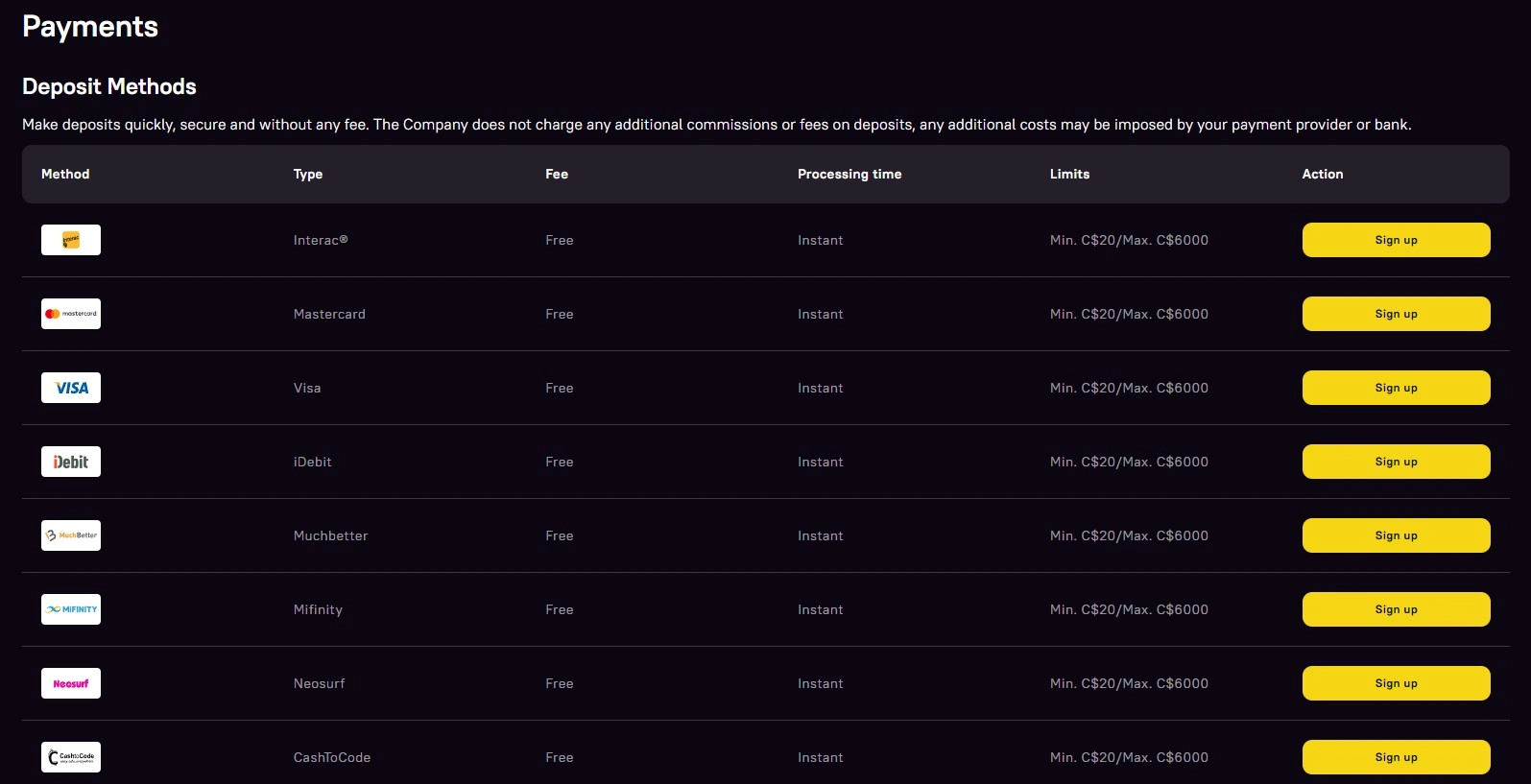
For payment questions that are not about identity documents, see the payment methods. It separates the cashier options from verification requirements so a request for KYC evidence is not confused with a problem involving the underlying card, wallet, bank or crypto route.
How to prepare documents that are easier to review
- Use a current government-issued photo ID with the full document visible.
- Choose a recent proof-of-address document showing the same residential address used on the account.
- Make sure text, dates, document numbers and names are readable.
- Avoid glare, heavy shadows, blur and cropped edges.
- Do not alter or digitally replace document details.
- Submit payment-method evidence only when requested and follow the specific instructions given for sensitive information.
- Keep the original files until the review is complete in case a clearer copy is requested.
These steps are practical rather than a promise of approval. Zoome still decides whether the evidence satisfies its checks. The aim is to remove preventable quality problems so the reviewer can evaluate the actual information instead of asking for another copy.
What happens if a document is rejected?
Zoome’s FAQ says that when issues are found during review, the user receives instructions explaining how to correct the documents. That is more useful than guessing whether the problem was file quality, expiry, a mismatch or another requirement. Follow the instruction attached to the rejection and replace only what needs to be corrected.
The Terms state that invalid documentation, including expired identification or mismatched name or address details, can lead to account restrictions. That makes it important to fix the underlying mismatch rather than resubmitting the same file in a different format.
If you believe the document is correct but the request is unclear, contact support and ask what specific field or evidence is missing. Keep the discussion focused on the requested verification step and avoid sending unnecessary personal information through channels that Zoome has not instructed you to use.
Privacy and document handling
KYC necessarily involves sensitive information. Zoome’s Privacy Policy describes identity data, contact details, financial data and transaction data among the categories it can process. It also states that verification providers and financial institutions may be sources or recipients of data where needed to deliver services and meet compliance requirements.
That makes account hygiene especially important. Access Zoome through the genuine site, use a unique password and do not send identity documents to a third-party review site, social-media account or unofficial contact claiming to speed up verification. If you need to check the operator and licence details before submitting sensitive material, use the trust and licence.
Only provide what the account workflow or official support asks for. A legitimate verification process may need sensitive documents, but that is not a reason to distribute the same files more widely than necessary.
KYC checklist before a cashout
| Check | What to confirm |
|---|---|
| Account details | Your legal name, date of birth and address are accurate. |
| Photo ID | The document is current, clear and fully visible. |
| Proof of address | The address matches the account and the document is readable. |
| Payment evidence | Have it ready if Zoome asks to confirm ownership of the method used. |
| Submission status | Check whether the operator is still waiting for another document. |
| Support | Use official support if the review exceeds the usual timeframe or instructions are unclear. |
The central idea is to treat verification as part of account administration rather than a last-minute obstacle. Accurate registration details, payment methods in your own name and readable documents give you the best chance of completing the process without unnecessary repeat requests.
Prepared by the Zoome Casino editorial staff.